


In which is presented a Telling of Irish Myth accompanied by a DEEP linguistic inquiry into the Irish Cath Maige Tuired, PART I.
Read below or listen and read on the Substack, or tune in to the episode on Apple Podcasts or Spotify: The Language of Irish Mythology Podcast. Remember to subscribe/follow and rate the podcast if you decide to head off to those platforms, that really, really helps both of us!
Note: A study of Irish Mythology is a dangerous thing. When you jump into this holy well you will fall down so far that you may just start rising up. So it is with The Keening Cave—there is so much to say that, by saying something, you feel like you have said nothing at all…even when you have said over 5,000 words of something-nothings…like all good myth, Irish stories have no beginning, and no end. Enjoy!

Tuatha De Danann and the Burning Boats
Why do all Irish Gods look like Caesar?
This is a question I think about quite often. Irish deities frequent the likeness of Rome and the Roman Catholic Church so oft that on many occasion to break them free is to break them apart, spilling the long—ago people’s spirits too, leaking that rotting liquid that really just needed a Passage Tomb instead.
Take for instance our Cailleach, the name of the Irish goddess and Creator deity, a sacred goddess for many of us. She comes from the Old Irish caillech, meaning “veiled one” or “hooded woman,” derived from caille (cah-lee) meaning “veil” or “hood”, which originated in our language as an early loanword from the Latin pallium, meaning “woollen cloak.” While we mean this linguistic genetic to refers to a divine hag and creator deity, the Latin pallium, the grandmother of our Cailleach, means the white woolen liturgical vestment worn over the chasuble by the Pope in the Catholic Church. I don’t think we mean it like the that.
Other scholars suggest that the Sean Gaeilge caillech comes from the Latin calyx (plural: calyces), a third-declension masculine noun, which is itself a loanword from the Ancient Greek kalyx, meaning “seed pod” or maybe “husk,” referring to the outermost whorl of sepals in a flower. Though I do not take this stance, for out of calyx we see the English words calyciferous, meaning “that which holds the calyx of a plant,” glycocalyx, meaning something like “A filamentous coating of glycoprotein and polysaccharide on the surface of bacteria and some other cells. Though the calyx does run into early Italian with calice, meaning “cup” or “goblet,” and as such hold some representation with an Irish creator goddesss…sort of…
It is important, therefore, when we enter into the hearth-fire of Irish Mythology we acknowledge the thousands of years of colonialism, of greed, of pain of un-managed grief, and the separation that follows. We need ancestral excavation, not just listening to other, native cultures. To come home is to sit with the spirits, to learn the death rattle, to experience the ceremony of hearth and sweat, to pray in the old ways. Without this full-bodied acknowledgment, our shapeless forms rolls through space-time in gravitational orbit about global cultures when our own sacred places, sacred Mountains made from the bones of heroes and hags, go untended. Whiteness is th
One of our greatest deities is named after the Pope’s cloak (or Greek flower anatomy). Think about that next time you pray to Cailleach. She is there. She is HERE! But she may no be dressed like the Pope, or a Greek flower. And she may surprise you. Let her surprise you…
Sometimes I wonder if we should visit her on our knees, asking for a new language, or a birth of the old.
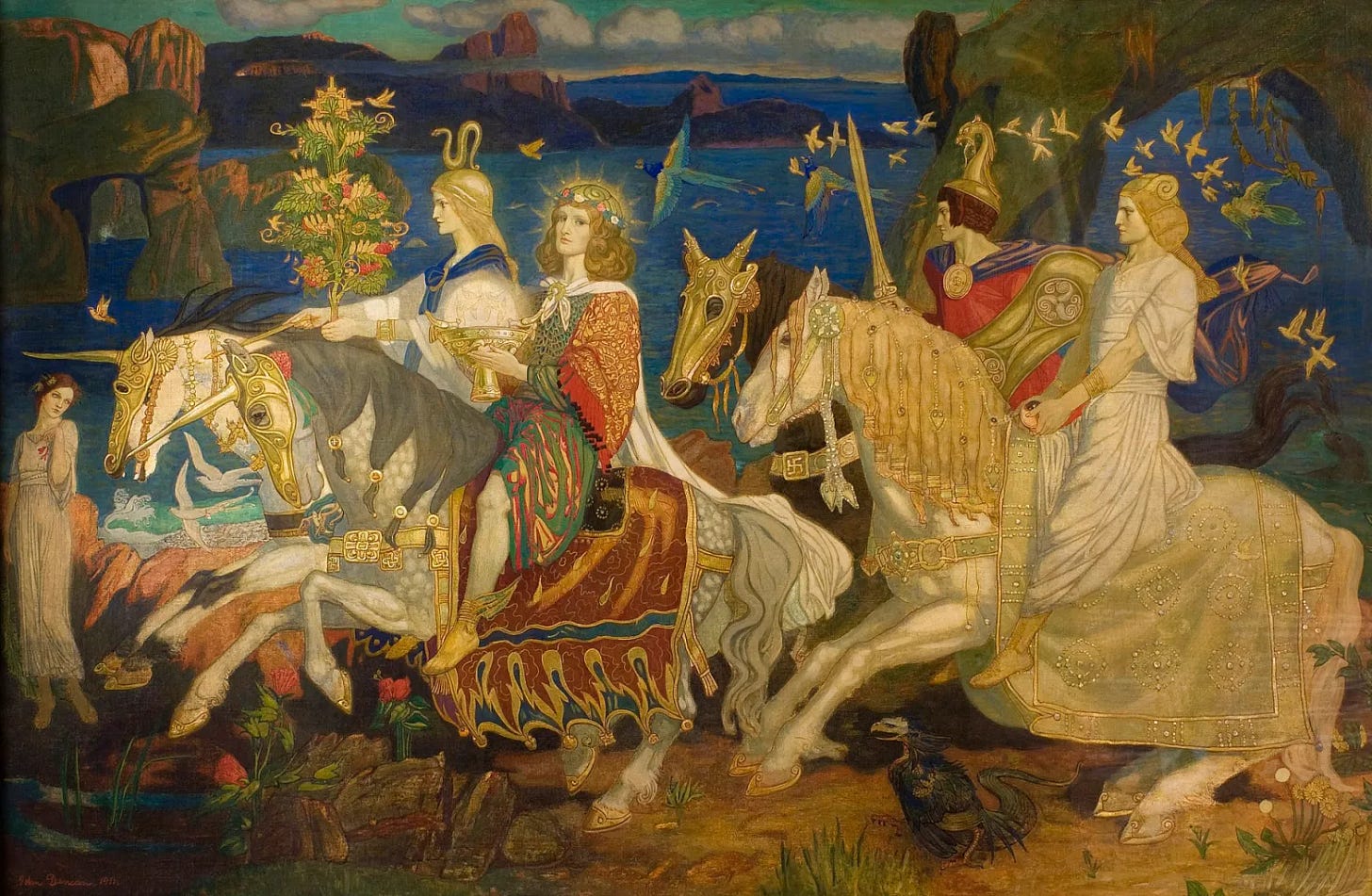
Image: “The Riders of the Sidhe,” 1911 by Scottish artist John Duncan, depicting the Tuatha Dé Danann as kings, queens, and warriors riding in procession. “The Riders of the Sidhe” is an example of the Celtic Revival and is currently housed at the McManus Galleries in Dundee, Scotland.
The Cath Maige Tuired is an angular story set within the circularity of the Irish soul, or anam, a modern Gaeilge word rooted in the Proto Celtic anaman, from the Proto Indo European h₂enh₁-, meaning “to breathe” that is suffixed by *-mn̥, which creates abstract action nouns from regular verbs. Anam is a fine word, but there are others, lest we forget: misneach (mish-nyakh), being “the spirit that won’t break” and croí (krEE), being “centre-heart.”
The Cath Maige Tuired also opens the window for our deities, and our heroes—the Old Irish curad, meaning hero that is rooted in the Proto Celtic karuts, which means something like “warrior-champion.” It is a tale with teeth such that if we plunge into her bowels and swim in the green-grey sluice there we may find a counterposed narrative at nearly every turn. But, leaning back, the story appears not in its naked polarity, but as a round tale that begins and ends at the beginning.
It is a true circle, a fine weave, constructed by the pin-point.
You can see the oral tradition imbibing the tale and its looseness, its repetitiveness, the way it holds words like a river holds leaves—just barely and always just skimming the surface like fairy fingers, like Aes Sídhe (or the Proto Celtic sîdos) rose from their Earthen mounds to tickle the water’s surface, just barely, with the bronze pad of doru little leaves (doru means oak).
The Cath Maige Tuired is a special text in the sense that it is a cauldron of Gods. Many tales in Irish Mythology reference the figures of the TDD, often times present what I find to be a confusing mess of names
and places and happenings that co-mingle into a life-time of study. But in the CMT, they are landed and embodied figures of clay and shape that speak directly with us, to us.
In an age that reduces fire-lit tales into digital videos and those thence into short-form instagram reels, the spirit of the Cath Maige Tuired grows increasingly elusive, slippery, and inconvenient, for it presents themes of kinship, hospitality, and sovereignty, balanced so precisely with horrifying colonialism and overt patriarchal power in the raw of body-trickery and sexual assault, but it does not ask us to judge, it does not show us evil. It does not show us outright villainy.
Though we yearn for it. We grind our teeth in the seeking of that polarity between white and black, life and death, good and evil. But the Cath Maige Tuired has something else in store for us.
She is a tale of those who do evil as a balance to those who do good. A tale of silence fighting the music, taking it too. A tale of a powerful man who sexually assaults the Land’s spirit in order to rule the world and also a tale of a man who loses it because he loses himself. It is a tale of transformation and metamorphoses that leaves it tantalizingly unclear if we are to defer to the Fomorians or to defy them, if we are to serve them, these supernatural and monstrous race depicted often as sea-dwelling, antediluvian giants or chaotic underworld demons, or to fight them.
The tale has answers, I think. Maybe, just maybe, if we stick with her long enough, she will speak. But like I said, her’s is an inconvenient trace and to get there, to arrive, is also to begin.
The story begins with:
1. The Tuatha De Danann were in the northern islands of the world, studying occult lore and sorcery, druidic arts and witchcraft and magical skill, until they surpassed the sages of the pagan arts.
First, we must ask: who are the Tuatha De Danann? What does this term, or name, mean? Tuatha De is most simply translated to “tribe of” or “people of,” such as would be common to use in describing a basic political unit in Ireland. Tuatha comes from the root, Túath, which thence comes from the Proto Celtic toutâ, meaning the same but a word that is rooted in the Proto Indo European *tewtéh₂, meaning “tribesman,” and as such here we find the very nature of Tuatha De: it is not just a general term describing “the people of” a place, but an “interconnected nomenclature of kinship,” such as that rooted, at least mycelially, in the term “Children of X.”
As such, if Tuatha De means “the interconnected kin of,” then it begs the question: who or what is Danann?
The grandmother tongue, or Proto Indo European has a thought. Deh₂r or deh₂nos, meaning “gift,” runs into the Proto Celtic, the ancestor of the Irish language, as danu, which thence runs into q-branch of Goidelic as dan, meaning “gift’ or “skill,” and the Welsh dawn, meaning the same.
Danu cognates with the Latin donum and the Greek doron. This same Proto Indo European root extends into the Proto Celtic verb da, meaning “to give,” that cognates well into the Sandskrit da, the Latin do/dare, the Greek didomi, and also, to keep this string going, the Old Church Slavic dati, all meaning the same, “to give.”
Across these Indo Cultures and Grandchildren of the Proto Indo European language, we witness a connection between Gifts and Skill. In the English we may say, “He is gifted,” to praise someone’s skills, but that “gift” is also “given,” an idea found in the reflective and very linguistically-redundant phrase, “He has been gifted with skill.” This string of thought culminates to the point that our linguistics pay homage to the ancient idea that skills are gifts for the giver and the receiver both. To exist in community, in other words, is to give and receive—such is the Latin reciprocus, or the modern day and completely overused words, reciprocity, meaning, in the original Latin, “forward and backward simultaneously.”
But there is more. Only a Creative Deity can create art in full reciprocity, that is, only a Creator can stand outside of the webby fabric of spacetime and yet create within it, only a Creator can craft with planetary skill that which is given away.
This is an important consideration in Irish Mythology with the Tuatha Dé Dannan, or The People of the Giver Danu, or Goddess Danu. Linguistically, it begs us to ask what it means to be a Goddess? It may mean, to Create without the of boundary of time, to make art in full reciprocity and without consideration to anything but resonance.
But there inlays a problem. Danu is not a word to be found in the medieval Irish manuscripts, manuscripts written in Sean Gaeilge, or Old to Middle Irish. Danu could be a play on words, perhaps, with the Proto Indo European *dʰenh₂-, meaning “to flow (like water),” given that the dark—waters and creative spirits are central to Irish symbolism and our stories. Or, as it is my opinion, the Proto Celtic danu slithered secretly into the Old Irish dán to create the well-usedphrase aes dána, or “the people of skill,” a phrase we will come back to later in our Telling of the Cath Maige Tuired in the figure of Lug.
And so to recap, the Tuatha De Danann are, in one sense, “the People of the Goddess Danu,” and in another sense, “the Interconnected Arts Weaving Éiru’s Land and Her People.” I will let you take your pick.
Second, it is important for us during these early moments (the first sentence still!) of this tale to realize that the Tuatha De Danann come from “the northern islands of the world.”
The original Sean Gaeilge, or Old Irish manuscript of the Cath Maige Tuired, found in Harleian MS 5280, Folio 63a-70b, found in the Catalogue of Irish Manuscripts in the British Museum, reads, “Túathai Dé Danonn i n- indsib túascertachaib an domuin,” (pronounced ee-nEE-uhn-shiv TOO-uh-skart-uh-hiv an dah-moyn) that translates as Northern Islanders, or those who live in the northern isles of the world.
While some scholars debate if this means those who live to the north in the Island of Ireland, I fall in line with those who see the world as a bigger place and ancient mythology as a fluid medium of memory, and what do migrating hearts need more than memory?
To understand this, we need to pick up the text once again.
2. They studied occult lore and secret knowledge and diabolic arts in four cities: Falias (FAL-ee-ass), Gorias (GOR-ees), Murias (MUR-ee-ass), and Findias (FIN-Dee-ass).
3. From Falias (FAL-ee-ass) was brought the Stone of Fal which was located in Tara. It used to cry out beneath every king that would take Ireland.
4. From Gorias (GOR-ees) was brought the spear which Lug (LUH-g) had. No battle was ever sustained against it, or against the man who held it in his hand.
5. From Findias (FIN-Dee-ass) was brought the sword of Nuadu (NOO-ah-dah). No one ever escaped from it once it was drawn from its deadly sheath, and no one could resist it.
6. From Murias (MUR-ee-ass) was brought the Dagda’s cauldron. No company ever went away from it unsatisfied.
In ‘The Earth Shapers‘ by Ella Young, an Irish poet and mythologist, she wrote in the 1910 edition:
“Ogma brought the Sword of Light from Findrias the cloud fair city that is in the east of the Dé Danaan world; Nuada brought the Spear of Victory from Gorias the flame-bright city that is in the south of the Dé Danaan world; the Dagda brought the Cauldron of Plenty from Murias the city that is builded in the west of the Dé Danaan world and has the stillness of deep waters; Midyir brought the Stone of Destiny from Falias the city that is builded in the north of the Dé Danaan world and has the steadfast of adamant.”
Young’s words and interpretation tempt a gripping correspondence…are we here presented with the Medicine Wheel of the Irish People and Spiritual Tradition?
Findias is a city on high ground, representing the element of Air and the direction East. Gorias is a city in sunny climes, representing the element of Fire and the direction South. Murias is a city as the great body of water, representing the element of Water and the direction West. And Falias is a fortress and steadfast city, representing the element of Earth and the direction North.
We see here in the beginning lines of this great story a proposed spirituality and Medicine Wheel that is rooted in “the occult lore and sorcery” of Northern Islanders. Though we still do not understand who they are, these four wizards, as they are described — Morfesa (MORA-Feh-sah) was in Falias; Esras (ESS-RAS) was in Gorias; Uiscias (ISH-kyEE-ISH) was in Findias; Semias (Shay-ahM ee-us) was in Murias — stand as masters of the magikal skill and impart upon the Tuatha De Danann the humble and mentor-seeking position of apprentices.
The story is telling us that these figures possess the Heart of a Student, though they have become the masters of art—as the text says, “they surpasses the sages of the pagan arts,”—but their heart is a school of skill, their knees are bent, and they have learned to suckle at the hearth-fire of masters.
The mythology treats this a good thing. This heart is the source of the Tuatha De Danann’s strength. But it makes them vulnerable, as being a student so often does, and they are ripe for the taking, for in the very next lines, it reads:
8. The Tuatha De then made an alliance with the Fomoire (FOM-MOR-eh), and Balor the grandson of Net (Nyetch) gave his daughter Ethne (EH-nya) to Cian the son of Dian Cecht. And she bore the glorious child, Lug.
The Tuatha De Danann’s first act in the Land of Éiru is to make an allegiance with those who seem to have also mastered the powers of skill and magik, the Fomoire. They are hungry for knowledge, for wisdom, and they are too trusting. Like the sages of the Northern Isles, the Fomoire are masters of art, but not necessarily the good medicine kind…
It is the Fomoire’s Balor that leads this confluence. He is he son of Net (nyetch), the God of War, it is argued, who is sometimes ascribed to the Tuatha De and sometimes ascribed to the Fomoire, perhaps, I think, because war can be the Good Medicine or it can be the Bad Medicine, for War is Art is Motion, but that also means it can create as well as destroy.
Before we move from this scene and the Tuatha De Danann’s Heart for Masters and Sages and the polarity of War, it is important to lay the foundation for Lug, a character born, just now, from the daughter of Balor, Ethne (EH-nya) and Cian.
Lug, who will be seen as the Sun God by many, is half Tuatha De and half Fomoire. The theme here is pregnant with symbology and bursting with meaning, a thing well-accomplished by mythology that says so much in so little. The Sun in the sky is masculine in the light and feminine in the dark. Many cultures carry this wisdom. This is just as it is with Lug in our story: he is the dark-figure of the Fomoire’s Ethne (female) paired with the leech and medicine-healer of the Tuatha De’s Cian (male); he is half darkness and he is half light. But he has some decisions to make, but we will see that in conversations to come.
Before we move on and plunge into the depths of this drama, as we are barely touching but the introduction as of yet, it is important to consider the arrival of the Tuatha De on the shores of Ireland.
9. The Tuatha De came with a great fleet to Ireland to take it by force from the Fir Bolg. Upon reaching the territory of Corcu (Cor-cah) Belgatan (BAH-l goh-tan) they at once burned their boats so that they would not think of fleeing to them. The smoke and the mist which came from the ships filled the land and the air which was near them. For that reason it has been thought that they arrived in clouds of mist.
The original Harleian MS 5280 of the Cath Maige Tuired reads, “i morloinges mór d’indsaigid,” or “a sea-voyage of great approach,” and maybe not so much that their “fleet was great” as is Gray’s translation, but rather that “their fleet’s voyage was great.” While this may be considered a small amendment to the translation, or really no amendment at all when you consider the finer points of jumping through two languages to get to our own, it is important to regard the spirit of their “seizing of Ireland,” as the text says. If the fleet is great than their “taking of Ireland” is at the hands of greatness, in either might or size, we don’t know. But if the fleet’s approach is great, the honour of “greatness” is bestowed not on their might but their mass, their interconnected whole as a people, a túath, if we remember and recall our beginning study of the name, Tuatha De Danann.
And that changes everything.
After riding the waves and landing on Éiru’s shores, they set to burn their boats. It is said that this is so that their journey has no rebuttal, no escape, no means for retreat. I think this could be true. But the Sean Gaeilge uses the term “teiched,” (TEH-hidd) that we translate to “fleeing,” or “flight,” as in “so that they would not think of fleeing to them.” But teiched is rooted in the Proto Celtic tekʷeti, meaning “to flee” but also, and more directly, “to abscond” or “to desert from duty.” As such, tekʷeti adds a layer of communal morality to the translation that “fleeing” fails to hold and falls far inadequate to.
They burned their boats in a cloud of mist so that their Hearts remained singular, non-absconded, unbroken, and tightly interwoven with the secure spirit of their social and sacred being.
The power of this moment reflects the power of the Irish soul and the sacred weave of that spirit, that spiorad (speer-ahd), with the Land of Éiru and the Gods.
History tells us that The Great Famine in Ireland lasted from 1845 to 1852, but we know it never ended. Over 1 million people died and over 1 million people emigrated, but did they leave? Can they leave? The living and the dead got on boats, sure, sailing the Atlantic and sailing the spirit road up into the Milky Way, or Bealach na Bó Finne, but did they flee? Did they abscond?
Irish Mythology tells stories of people coming from afar. Ireland is mingling, it has no borders, Céad míle fáilte, or “a hundred thousands welcomes,” isn’t for the tourists, it is for all the souls, living and dead, that call upon the name of Éiru, or Ireland. We will see this played out in another story, the tale of Amergin Glúingel, but let us hold that another day, for the tale of the Cath Maige Tuired is changing, transforming from an introduction of The People, the Tuatha De, to a battle-saga and spirit-fury of a culture.
The next scene is anchored to the angularity that I mentioned earlier. It is here that the weighed polarity begins:
11. Nuadu’s (NOO-ah-dahs) hand was cut off in that battle--Sreng mac Sengainn (Shreng mac SHENG-gin) struck it from him. So with Credne (KREHd-nyuh) the brazier helping him, Dian Cecht the physician put on him a silver hand that moved as well as any other hand.
12. Now the Tuatha De Danann lost many men in the battle, including Edleo mac Allai (ED-Leo mac ALLL-eye) , and Ernmas (AIR-nah-mus), and Fiacha (FI-AH-Hha), and Tuirill Bicreo (TIR-ill BIK-ruh-oh).
13. Then those of the Fir Bolg who escaped from the battle fled to the Fomoire (FOM-MOR-eh), and they settled in Arran (AR-rahn) and in Islay (ISS-law) and in Man and in Rathlin (RAH-lin).
The story tells us that Nuadu is the first leader of the Tuatha De.
His name is considered to be rooted in the Proto Celtic noudent, which means something like “to acquire through hunting,” though some scholars have suggested a Germanic origin and point to the Grandmother tongue of Proto Indo European, focusing on the word *neu-d- instead.
In either case, it is Nuadu that led them to victory in what is known as the First Battle of Maige Tuired when the Tuatha De fought their distant kin, the Fir Bolg. We can see in this text a reference to that battle and the scraggly bits and pieces of its outcome. While the Tuatha De won the battle, their king’s arm was cut-off by Sreng mac Sengainn (Shreng mac SHENG-gin). This detail is carried beside the death of warrior-heroes as though it ranks among them, as though it is death being described by the removal of an arm, not just a wound. In other words, it is not just Edleo mac Allai (ED-Leo mac ALLL-eye) and Ernmas (AIR-nah-mus) and Fiacha (FI-AH-Hha) and Tuirill Bicreo (TIR-ill BIK-ruh-oh) that died in the battle with the Fir Bolg, but something about Irish kingship died as well…
It is this moment that our story is born, for without Nuadu losing his arm, the rest of the Cath Maige Tuired would not have happened, it can be supposed. In storytelling, we would say this is the great drama, this is when the Titanic springs a leak, when Hamlet going mad, when Macbeth blurs what is foul and fair. This is Achilles’ rage that sets the Argives back.
In ancient Irish custom, kingship was a sacred and conditional office. An office quite dissimilar to the medieval notion of the kingship through aristocracy or the later forms of gentry and nobles. It was not seen as absolute rule, but rather the king, or rí, maintained his Right through justice and honor by acting as a husband to the Land in ritual marriage. This is called bainis rí (bahn-ish rEE). Kings were selected through tanistry and not primogeniture, that is through selecting the strongest (inside of the body and out) male in the broader family, and not the oldest in direct line.
But there is more. The sacred rite of geasa (gAY-sha) can be see as a marriage-shall over the sacred union of King and Sovereignty Goddess, that is between the ruler of Ireland and the Land herself. It is a pact dictating honour and strength and respect. Nuada’s rule is founded in his marriage with the Land in a sacred and balanced union of male and female, the walking-clay and the clay herself. But geasa also means wholeness, for bainis rí is strong only so far as fír flathemon (FEER FLAuh-hun), a term meaning “true judgment” or “cosmic justice” remains whole.
…remains whole. Bainis rí is the King’s wholeness that maintains the relationship and kinship between The People, or Tuatha De, and the fertility and sacred power of the Land and her goddesses.
When Nuada loses his arm, fír flathemon (FEER FLA-uh-vun) is enacted and through geasa he is deprived of bainis rí, the right of kingship.
Many scholars focus on the fact of Nuada losing his arm. But I want to focus our attention on a different aspect. It is important, I think, to consider which arm.
According to Manuscript 1319 at Dublin’s Trinity College, the concept of Nuada losing his “right-hand” is connected with bainis rí, the hope of kings. It reads, “Sreang bern cloidimh don airdrigh do Nuadhaid gur theasg bile an sgeth an laimh ndes ac a ghualaind, gu ndroclair an lamnh gu triun an sgeth le for talm.” Or, “Sreng dealt a blow with his sword at Nuada, and, cutting away the rim of his shield, severed his right arm at the shoulder; and the king’s arm with a third of his shield fell to the ground,” as translated by J. Fraser.
The phrase “right arm at the shoulder” is “laimh ndes ac a ghualaind,” (lawv n-etch ac ah hhole-ind) and the word for “right” is ndes (n-etch), as in laimh ndes (lawv n-etch), or right-hand. When Nuadu looses his laimh ndes (lawv n-etch), he looses the kingship, like a quiver looses its arrows and the people lose their connection with Land.
There is an interesting linguistic connection between laimh ndes (lawv n-etch) and its connection with bainis rí in the Proto Slavic language, a sister tongue to Irish. *Berďa is a Proto Slavic word that holds the connection between one’s “right hand” and the idea of pregnancy, which itself depends on the wholeness and union of male and female. Through this window, though a bit blurry, we may also consider that laimh ndes is like a Mother’s hope when with child—meaning something like the sacred union of the masculine and feminine, like a prayer that hope holds.
The Old Irish Ndes (n-etch) becomes dheis (dyesh) in modern Irish, meaning “right side,” which lives in phrases such as ar dheis Dé go raibh a anam, (air dyesh deh go rav ah ahnam) meaning “may his/her soul be on the right of God,” which one may say at funerals or death-songs.
Nuada’s loss of his right arm loses him the kingship and it severs the Tuatha De’s connection with the Land and her spirits. What comes next, changes everything.
14. There was contention regarding the sovereignty of the men of Ireland between the Tuatha De and their wives, since Nuadu was not eligible for kingship after his hand had been cut off. They said that it would be appropriate for them to give the kingship to Bres (BRESH) the son of Elatha (eL-ah-hah), to their own adopted son, and that giving him the kingship would knit the Fomorians’ alliance with them, since his father Elatha mac Delbaith (eL-ah-hah mac DYEL-bah-eth) was king of the Fomoire.
In this state of separation, the Tuatha De turn to the Fomoire. While the English translation of the tale reads “They said that it would be appropriate for them to give kingship to Bres,” the original Old Irish, the Sean Gaeilge, reads, “ba cumdigh,” (bah coo-dih) or, “it would be protecting.” Cumdigh means something like “covering” or “protection” or “container,” and may share linguistic relation with other Old Irish words such as cumtach (coo-tahk), meaning “structure” or “building,” or cumhdach (coo-dah), the masculine plural of cumhdaigh (coo-duh), which is generally considered to mean “a cover” or “a wrapper,” like the roof of a house (such as the phrase “Teach a chumhdach (tahk ah hoom-dah)) and is a term woven throughout the early Christian period (which would be about the same historical time of this manuscript’s writing, from about the 7th through 10th century CE) as a protective vessel for sacred items, one used in religious or historical contexts to refer to a shrine, box, or protective case for a relic or book.
If this is true, then cumdigh (coo-dih) used in the Manuscript of the Cath Maige Tuired may mean something like “a collection,” or, “protection through containment when all you have is pieces and bits.” That is, when one’s connection with the Land and her spirits and deities withers like autumn grasses, it is the Fomoire that the Tuatha De turn to to collect them, to hold them.
But why Bresh? Or better, who is Bresh? And what happens next? The end comes in balefuls of pain to write a new beginning and the battle begins…
Join us next time, as we continue this Telling of the Cath Maige Tuired.
Grá mór! Slán go fóill.
. . .
Featured image: 1960, Lough Talt, Co. Sligo, from “The Photographic Collection, B024.05.00002” by Dúchas © National Folklore Collection, UCD is licensed under CC BY-NC 4.0.
I am neither fluent in the Irish languages (Gaeilge, Sean Gaeilge or Proto Celtic) nor is my pronunciation unworthy of amending. I have long been a student at their feet but I am far from perfect. If you find error in my spelling or pronunciation, comment below the fix and I will thank you dearly!
#1: the Insular Celtic peoples (Irish, Welsh, Scottish, Briton, Manx, Cornish) are threaded between colonial history’s nomenclature of who we are and the hearth-song of our own private liturgies, the ceremonies of quiet winter-breath so much like the snakes that have long run from those who come in big ships bearing big books. The Irish are Éire, us homeless children hearthed, long ago, under the arching sleep—tents of the lush rolling hills and the deep arching lodges of warm wet island forests by the Sovereignty Sisters, Ériu, Fódla and Banba. The Welsh are Cymry of the Land Cymru, meaning “the people” or “fellow landfolk,” but Welsh in the Old English is wealh, meaning “foreigner” and as a noun it means the “strangers” living “over there,” and, not surprisingly, as a verb, spelled welch, it indicates someone who “avoids paying debts.” History is complex and our blood-memory lives with impassible nuance, though I have decided to maintain the colonial nomenclature so as to maintain the accessibility of this text. Forgive me and let us grow together.
#2: I am American-born clay remembering the spirit-weave of my ancestors with an Irish grandmother and a Welsh grandfather, my namesake, Ffrith (or Firth). My grandmother’s ancestors trace our lineage in Lowpark, Co. Mayo as far back as the “census” of 1500 CE. I do not claim to be a member of the modern Irish culture and I do not speak Gaeilge fluently, the modern Irish language. But Gaeilge comes from Sean- agus Mheán-Ghaeilge (Old and Middle Irish) which I know moderately well and Sean- agus Mheán-Ghaeilge comes from Proto Celtic, which is what I know best.
